
Best Quran revision Techniques for Memorised Surahs

Although memorizing the Quran is an excellent achievement, it must be regularly reviewed to be up to date. The best memories might disappear if they are not regularly reviewed. A clear revision plan allows for improved memory, mistake correction, and fluent recitation.
At Quran Verse Quest, we use a personalized timetable to help students with both memorization and revision. Some of the best methods for reviewing memorized Surahs are listed below.
Purpose of Quran Revision in a Memorization Plan
Revision is more than only reciting the Surahs. A true revision includes:
- Finding and fixing areas of weakness.
- Increasing fluency and Tajweed while maintaining perfection in memory and recitation.
Memorisation builds up in your routine and your heart through revision, which changes it from something you just know once. If you don’t revise what you’ve memorized, Your Tajweed accuracy may weaken, your fluency may decline, and small errors may appear in your recitation.
Daily Prayers: Incorporating Quran Revision into Salah
The greatest time to revise is during your five daily prayers. Practice various sections of the Quran in each Salah rather than only reciting brief Surahs. This guarantees that you will eventually cover all of your memorized Surahs in smooth and natural way.There are both practical and spiritual advantages to using Salah as a revising tool. You are offering your memorisation back to Allah in worship, which has a spiritual value. The useful part is that regular practice in these official contexts improves memory recall. By switching up the parts you repeat from memory, you may make sure that each Surah receives consistent attention.
Monitor and Fix Errors During Quran Revision
Early mistake detection is essential for a strong Quran memorization. One useful method is to record your recitation and play it back.
Focus on highlighting the weaker parts in your Mushaf (Quran) and review the difficult sections more often until they become strong and firm in your memory.
Methods consist of:
- Record audio with a cell phone or other recording device. Later, listen again and compare it to the right recitation to identify any gaps or mispronunciation(
- Use Mushaf (Quran) to visually identify any weak Ayahs or Surahs by marking them with a pencil or bookmark tags. Use Tajweed colour codes If available.
- Feedback from peers or tutors: Allow a skilled instructor or experienced reciter to monitor and correct you on regular basis. Sometimes minor problems that only expert listeners can pick up on might be found in something you consider powerful.
Build a 90-Day Quran Revision Schedule
A 90-day strategy is used by many Huffaz(Qur’an memorize), who revise seven or eight pages every day. This guarantees that the entire Quran is updated every three months, for a total of four full cycles annually. A smaller but consistent approach will nevertheless produce long-lasting outcomes even with less time.
This is how such a plan could be organised:
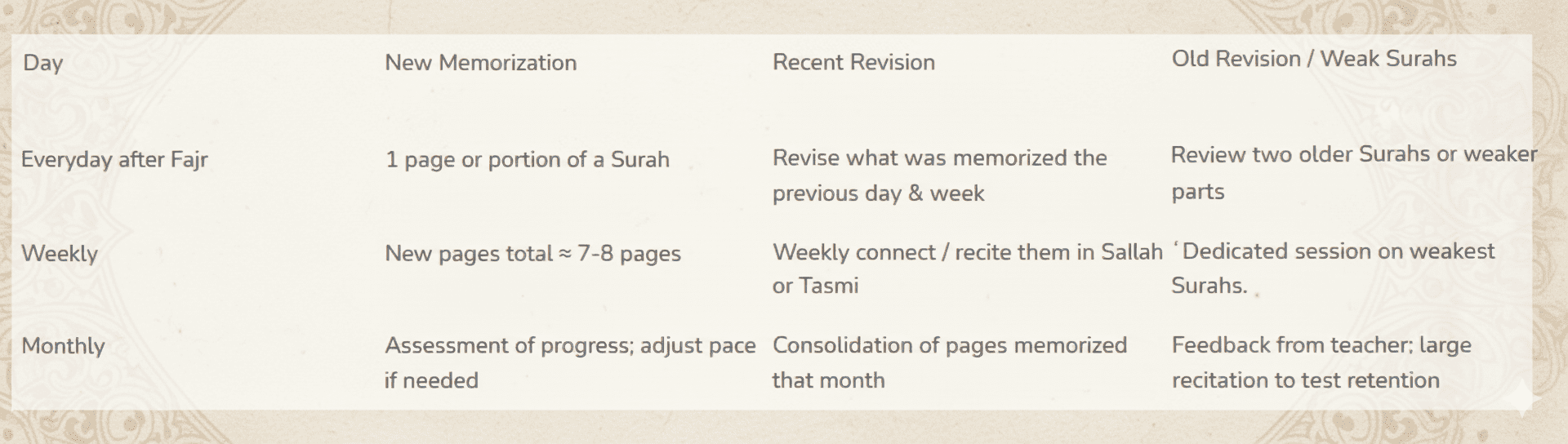
- Daily Goal: Read seven to eight pages. Start with fewer pages but stay consistent if this is too much.
- Weekly Check-in: Set aside time every week to go over all of the pages that were read that week and make the connections between them so that the surahs make sense.
- Monthly Assessment: Select particular weaker Surahs or pages to review at the end of each month; you may even read or recite them out in front of a teacher or in a test-like environment.
- Flexibility: Plans will be disrupted by illness, travel, and life events. Allow for some buffer days and revisions, but don’t stop completely.
Strengthen Weak Surahs Through Quran Revision
Over time, some Surahs certainly get weaker. Pay close attention to these by saying them in Salah, listening to skilled reciters, and going over them every day until they feel strong again.
Strategies consist of:
- Daily Focused Revision Sessions: At least once a day, dedicate five to ten minutes to focused mini-sessions in which you recite only the Surahs or Ayahs that require repetition.
- Active listening: Play Surah recordings narrated by professionals; listen to the Mushaf. Practicing the flow, proper tajweed, and pauses and stops guides in improving pronunciation and memory.
- Group recitation: This increases self-assurance and exposes you to responsibility; listening to others recite also helps you remember things.
Advanced Quran Revision Tools and Techniques
To make your revision plan more comprehensive and long-lasting, try these more advanced tools and techniques:
- The spaced repetition technique involves going over freshly learnt material more often while progressively lengthening the time between revisions. Educational research backs this up, and many recent Quran memorization programs use it.
- A revision chart or murājaʿah board is a visual tracker that shows when each of the parts you have memorised has to be reviewed and categorises them into fresh, recent, and old sections. Observing your progress can inspire you.
- Technology Use: Tajweed colouring, voice recording, and playing are features of apps or digital Mushafs that assist in identifying weak points. Recitations and audio loops are also available for use during light labour, such as driving.
- Connection Sessions (Wiqayah): To increase confidence and fluidity, recite all of your memorised Surahs aloud without Mushaf(Quran). You can do this every couple of weeks.
Teaching Others/Teaching Yourself Aloud: If at all possible, instruct a peer or explain the Tajweed regulations and the meanings of the Ayahs. Teaching strengthens memory and expands comprehension.
Here are some sample schedules that you can modify to put everything said above into practice:
- Every day, set an intention (niyyah) by reminding yourself of the purpose of your memorisation and revision.
- Realistically, it is preferable to proceed slowly and methodically rather than rushing and having a lot of weak or forgotten pieces.
- Intensity is inferior to consistency; frequent tiny reviews spaced out over extended periods of time are preferable to infrequent large ones.
- Accountability: Staying on course requires frequent check-ins with a group, friend, or instructor.
Regular revision is the key to maintaining Quran memorisation. By using regular prayers, correcting, according to a timetable, and concentrating on weaker Surahs, you can quickly and steadily develop your Quran memorization. Consider working with our knowledgeable teachers at Quran Verse Quest if you’re looking for organised advice on creating a successful revision strategy for memorising the Quran.
Our knowledgeable instructors help students all around the world create individualised study plans that increase their self-assurance, accuracy, and relationship with the Holy Quran.We offer comprehensive tactics to assist you.Determine which Surahs need improvement and plan targeted revision sessions.Under the guidance of an expert, maintain your Tajweed and fluency.For long-term retention, strike a balance between revision and memorisation.
Explore our entire course selection at Quran Verse Quest to further enhance your Hifdh and general Quran learning. Start by learning Arabic pronunciation with the Noorani Qaida Course, and then improve your fluency by enrolling in our Quran Reading Course. Enrol in our Tajweed Course if you want to recite with precision and elegance. The Quran Memorisation Course and Tafseer Course aid in improving the recall and comprehension of Allah’s verses for more experienced students. Our Islamic Studies Course is another way to deepen your understanding and make the connection between your faith and everyday life. For outside resources, go to IslamicFinder.org to schedule Salah times and keep your Quran review schedule consistent, and Quran.com to hear professional recitations.